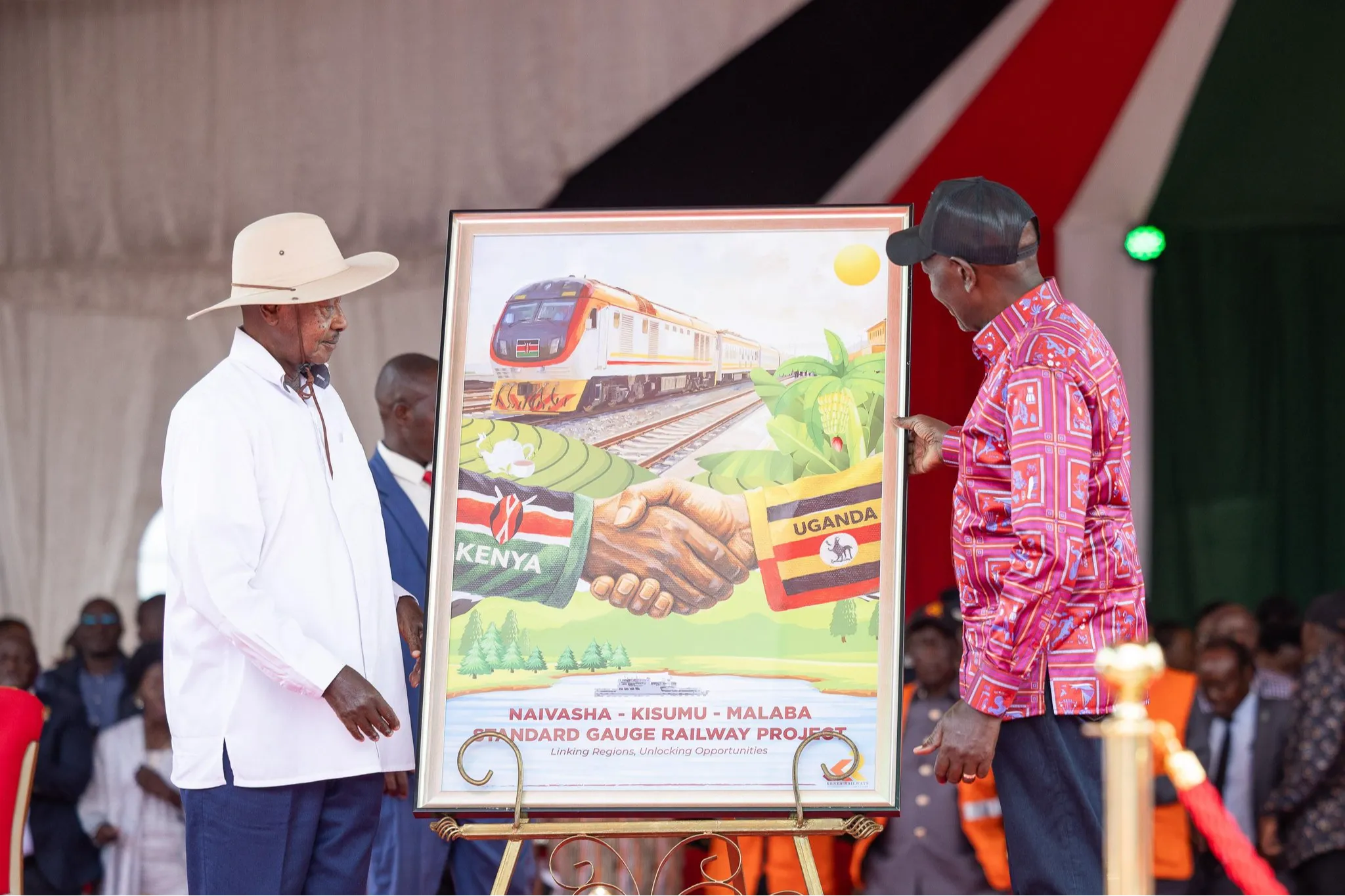
KISUMU, Kenya — Kenya and Uganda have taken a significant step toward reviving a long-delayed regional railway vision, with Presidents William Ruto and Yoweri Museveni jointly inaugurating a key section of the Standard Gauge Railway (SGR) expected to transform trade across East Africa.
The launch marked the start of the 107-kilometre Kisumu–Malaba segment, a crucial link in the planned nearly 1,000-kilometre corridor stretching from the Port of Mombasa to the Ugandan border.
This extension aims to complete a seamless transport route connecting Kenya’s coast to Uganda and beyond. Once linked to Uganda’s planned Malaba–Kampala railway, the line is expected to become a backbone for East African trade.
Coverage of the groundbreaking was initially reported by Vivid Voice News our sister publication under the editorial leadership of Michael Wandati, who highlighted the transformative potential of the project for regional logistics and trade.
Officials project that the completed Nairobi–Kampala corridor could reduce travel time from about 14 hours to just four, while cutting freight costs by up to 35 percent, offering a major boost to efficiency and regional competitiveness.
Speaking at the ceremony, President Ruto described the project as transformative:
“It is in moments such as this… that the destinies of our people, our cities, and our nations are shaped.”
The SGR extension has faced several years of delays, mainly due to financing challenges after China reduced infrastructure lending under the Belt and Road Initiative. Construction had stalled more than 350 kilometres short of the Ugandan border, raising concerns about the railway’s long-term viability.
Kenya has since adopted a new funding approach, including revenue from a railway development levy, to ensure the project’s completion.
The Kenya segment from Naivasha through Kisumu to Malaba is estimated at over $5.5 billion, while Uganda’s connecting line to Kampala is projected at about $3 billion.
The modern SGR draws inspiration from the historic Uganda Railway, built over a century ago to link the Indian Ocean to the interior. That line was once the economic backbone of the region, supporting the growth of cities such as Nairobi and Kisumu.
However, decades of underinvestment, ageing infrastructure, and the shift to road transport led to its gradual decline. The SGR aims to replace the old metre-gauge system with a faster, more efficient network aligned with the East African Community’s broader railway master plan.
Economic potential and regional stakes
According to Vivid Voice News reporting by Michael Wandati, the SGR is expected to unlock economic opportunities across western Kenya and the wider Great Lakes region by:
- Lowering transport costs for bulk goods
- Improving access to export markets
- Streamlining supply chains
- Supporting industrialisation along the corridor
Nearly 70% of cargo handled at Mombasa is destined for Uganda and other landlocked countries, underlining the corridor’s strategic importance.
For Uganda, the enhanced rail connectivity is critical to reducing import and export costs, which currently rely heavily on slower and more expensive road transport.
President Museveni has emphasised that delays in completing the railway have limited Uganda’s access to seaports, increasing costs for businesses.
Regional competition and strategic significance
The project also highlights competition over trade routes in East Africa. President Ruto has warned that Kenya’s position as the primary gateway to the region is not guaranteed, especially as neighbouring countries invest in alternative corridors.
Completing the SGR link to Uganda strengthens Kenya’s role as a logistics hub for East and Central Africa, connecting markets in Rwanda, South Sudan, and the Democratic Republic of Congo.
If completed as planned by around 2028, the Kenya–Uganda SGR link will represent a milestone in regional infrastructure development and serve as a model for cross-border cooperation and sustainable infrastructure financing.