
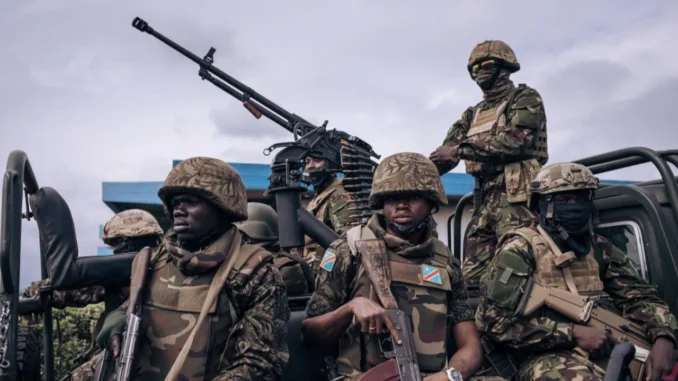
KINSHASA, DR Congo — The Democratic Republic of Congo (DRC) has filed a case against Rwanda at the International Court of Justice (ICJ), accusing its neighbour of violating multiple international treaties through alleged military involvement and support for armed groups operating in eastern Congo.
In a statement announcing the legal action, the Congolese government alleged that Rwanda deployed forces and supported armed groups carrying out unlawful military operations on Congolese territory, actions it says have contributed to years of instability and violence in the country’s eastern region.
Speaking on Friday, Congolese Justice Minister Guillaume Andali said the case seeks accountability for alleged violations of international conventions relating to the prevention of genocide, racial discrimination, women’s rights, and the prohibition of torture.
According to the application filed before the Hague-based court, the DRC is asking the ICJ to order Rwanda to halt the alleged violations and award reparations to both the Congolese state and victims affected by the conflict.
The filing marks the latest legal effort by Kinshasa to hold Kigali accountable over its alleged role in the long-running insecurity that has plagued eastern Congo.
The ICJ will now review the application and determine whether the case can proceed under its jurisdiction.
As of publication, Rwanda had not publicly responded to the latest filing.
However, Kigali has consistently denied allegations that it supports armed groups operating in eastern DRC, including the M23 rebel movement.
Rwanda has repeatedly rejected accusations from the Congolese government, the United Nations, and several Western governments that it backs the M23.
Nevertheless, UN experts and multiple international actors have maintained that there is evidence linking Rwanda to support for the rebel group, a claim Kigali continues to dispute.
This is not the first time the DRC has sought legal action against Rwanda before the ICJ.
An earlier case filed in 2001 was later withdrawn by Congolese authorities.
In 2006, the court dismissed another Congolese case after finding that Rwanda had not accepted the court’s jurisdiction in relation to the treaties cited at the time.
The latest filing appears designed to overcome previous jurisdictional obstacles by invoking several international conventions to which both countries are parties.
The conflict between Rwanda and the DRC is deeply rooted in the aftermath of the 1994 Rwandan genocide, during which an estimated 800,000 people, mostly ethnic Tutsis, were killed by Hutu extremists.
Following the genocide, approximately one million Hutus fled into what is now the Democratic Republic of Congo, including individuals accused of participating in the mass killings.
The influx heightened ethnic tensions in eastern Congo, particularly among the Banyamulenge, a Congolese Tutsi community that increasingly viewed itself as vulnerable to attack.
Rwanda subsequently launched military interventions in Congo, arguing that it was pursuing individuals responsible for the genocide and protecting its national security interests.
A major source of tension remains the Democratic Forces for the Liberation of Rwanda (FDLR), an armed Hutu group operating in eastern Congo that includes some individuals linked to the 1994 genocide.
Rwanda considers the FDLR a continuing security threat and frequently accuses the Congolese government of cooperating with the group.
Kinshasa has repeatedly denied those allegations.
The conflict intensified further after the M23 rebel group captured significant territory in eastern Congo, including the strategic city of Goma, during renewed fighting earlier this year.
Despite diplomatic efforts and a peace agreement brokered with support from the United States, clashes and insecurity have persisted across parts of the mineral-rich eastern region.
The latest ICJ case adds a new legal dimension to one of Africa’s most complex and enduring geopolitical disputes.