
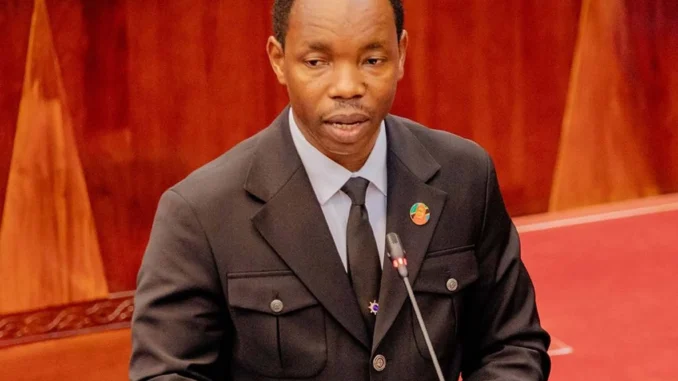
DAR ES SALAAM, Tanzania — The Tanzanian government has suspended political rallies across the country until further notice, citing security concerns and warning that authorities will not tolerate activities deemed capable of disrupting public order.
The directive, announced by Minister for Home Affairs Patrobas Katambi, has sparked sharp criticism from opposition parties, which accuse the government of undermining democratic freedoms and restricting political participation ahead of anticipated demonstrations calling for reforms and accountability.
Addressing Parliament, Katambi said security agencies had identified emerging threats, including individuals allegedly found in possession of weapons while planning criminal activities.
“We should focus on building our economy,” Katambi said, adding that Tanzania was preparing to host a major international trade fair expected to attract visitors from multiple countries.
“During this period, we will not tolerate anyone who engages in any form of disorder,” he added.
The suspension effectively halts political rallies nationwide and marks a significant policy shift from reforms introduced by President Samia Suluhu Hassan in 2023, when she lifted a six-year ban on political gatherings imposed under the administration of her predecessor, the late President John Magufuli.
At the time, President Samia said political parties had a constitutional right to hold rallies but urged leaders to conduct their activities responsibly and avoid inflammatory rhetoric.
The government’s latest directive has drawn immediate backlash from opposition parties, with ACT Wazalendo describing the suspension as unlawful and pledging to challenge it in court.
The party accused the ruling Chama Cha Mapinduzi (CCM) government of using state institutions to suppress political competition and silence dissenting voices.
CCM had not publicly responded to the allegations by the time of publication.
Veteran opposition politician Joseph Selasini of the Chadema party argued that the ban comes at a time when opposition rallies have been attracting significant public interest, particularly events focused on demands for justice following last year’s post-election violence.
According to Selasini, the restriction risks further shrinking civic and political space in the country.
The suspension comes amid lingering tensions following the aftermath of Tanzania’s October 29, 2025, general election.
A commission of inquiry established by President Samia found that 518 people died from unnatural causes during the unrest that followed the election, including 197 people who were fatally shot.
The findings shocked many Tanzanians and international observers, given the country’s long-standing reputation as one of East Africa’s most politically stable nations.
The election itself was controversial, with the country’s two main opposition presidential candidates reportedly barred from contesting, a move that intensified criticism from opposition groups and human rights organisations.
Political rallies were first banned between elections in 2016 under President Magufuli, who argued that continuous political campaigning distracted the country from its economic development agenda.
The restrictions were widely criticised by civil society groups and opposition leaders, who viewed them as an attempt to weaken political competition.
President Samia’s decision to lift the ban in 2023 was welcomed as a major democratic reform and was seen as part of broader efforts to improve political freedoms and national reconciliation.
However, the latest suspension has raised concerns that Tanzania may be reversing some of those gains as political tensions continue to rise.
Analysts say the coming weeks could prove critical, particularly if opposition parties proceed with legal challenges and planned demonstrations despite the government’s directive.